Behind NERV Disaster Prevention: Revolutionizing Japan’s Disaster Alerts
In Japan, a country frequently hit by earthquakes and natural disasters, there’s an app called “NERV Disaster Prevention” (NERV for short, pronounced “nerf”) that delivers crucial disaster information. If the name rings a bell, you’re not alone. We sat down with Daiki Ishimori and Takashi Nukaya from Gehirn Inc. the creators of this unique app, to learn more.

Daiki Ishimori | CEO, Gehirn Inc.
Starting programming at age 10 and launching a rental server service by age 12, Daiki founded Gehirn in July 2010. In the aftermath of the 2011 Great East Japan Earthquake, he began providing disaster information via Twitter under the handle @UN_NERV. He released the NERV disaster app in 2019 and served as a director of the Security Camp Council.
Takashi Nukaya | Executive Director, Gehirn Inc.
Takashi first connected with Daiki in junior high after signing up for a free server service that Daiki ran. Since then, he’s spearheaded the UI/UX design for Gehirn’s services, building the foundation for its visual identity.
NERV Disaster Prevention – Delivering disaster info at lightning speed
— Many people probably found your app useful during recent events like the Noto Peninsula earthquake or the J-Alert warnings. Could you start by explaining what NERV Disaster Prevention is?
Daiki: NERV Disaster Prevention (NERV for short, pronounced “nerf”) is an app that delivers real-time disaster information, such as earthquake, tsunami, and volcanic eruption alerts, as well as warnings for landslides, floods, and inundation risks. The information is optimized based on the user’s location or registered areas. We receive disaster data directly through a dedicated line connected to the Meteorological Service Support Center and collaborate with various agencies to provide timely and comprehensive alerts. This enables us to offer some of the fastest disaster notifications in Japan.
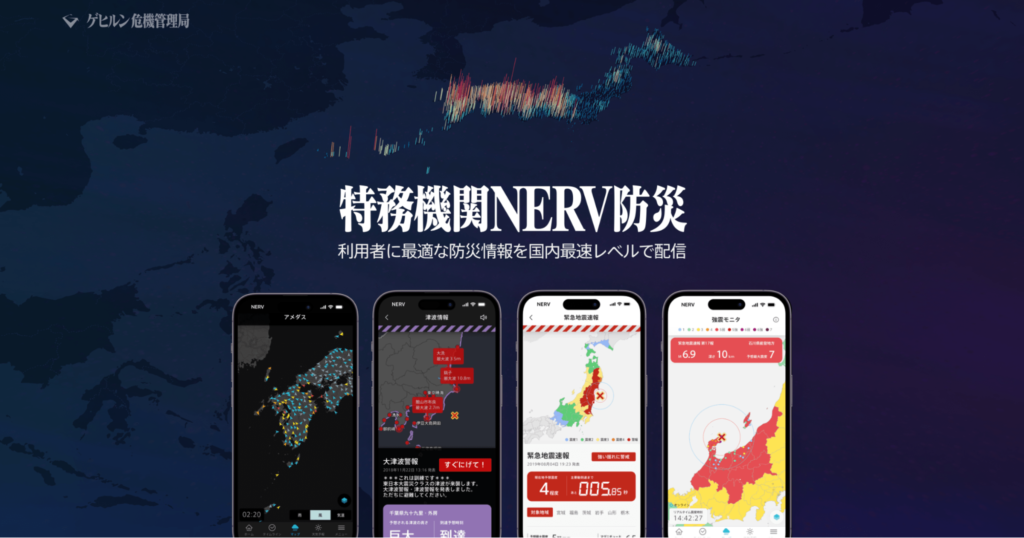
Daiki: The app’s name, “NERV,” comes from the fictional organization in the Evangelion series. I’ve always been a fan of Evangelion, so when I started a Twitter account in February 2010 to share weather alerts, I named it after NERV. We continue to use the name with permission from the rights holders.
— The app comes with several disaster prevention features. What do you prioritize the most?
Daiki: One major focus is accessibility, ensuring everyone can receive information in the format that best suits them. For example, we offer a voice reading function and color schemes adapted for different types of color vision. Another priority is reachability. No matter how refined the user interface or how advanced the technology is, if the app’s servers crash during a disaster, it’s useless. Ensuring that people can quickly and reliably access information is crucial.
Accessibility for all
— Let’s dive deeper into accessibility. The ability to customize the color scheme based on color vision types is quite rare. What motivated this feature?
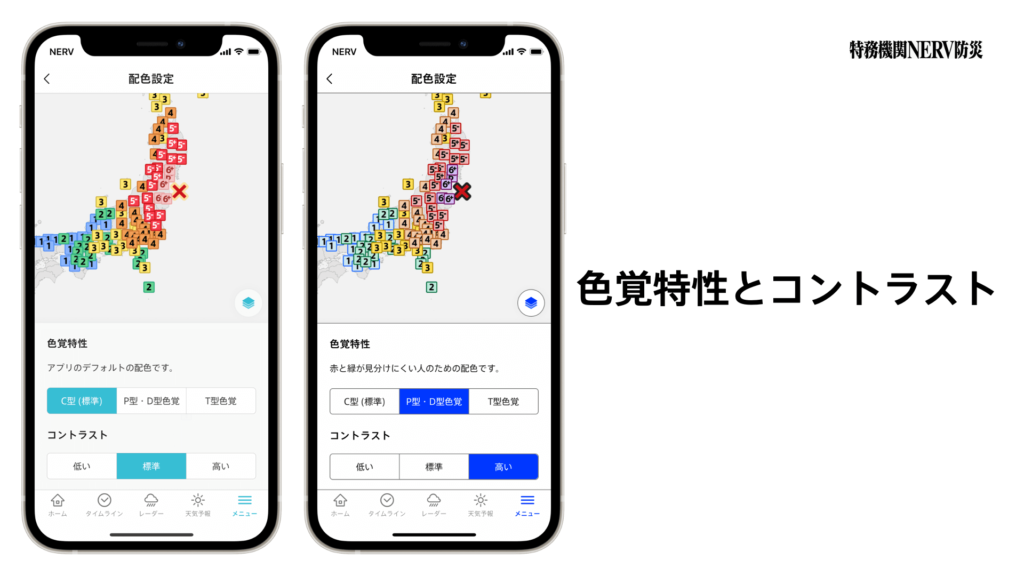
Daiki: I have P-type color vision myself (difficulty distinguishing between red and green), so this is personal. Color vision issues can be congenital, but they can also arise from injuries, illness, or simply aging. It’s said that most people experience changes in their color vision by their 80s, with many struggling to see blue as they age. We’ve noticed older users tend to choose high-contrast themes designed for T-type color vision (difficulty distinguishing between blue and yellow). That’s why we made it so that users can always switch to a display that suits their current needs.
— When you account for contrast settings and other factors, you must create quite a few design patterns to manage.
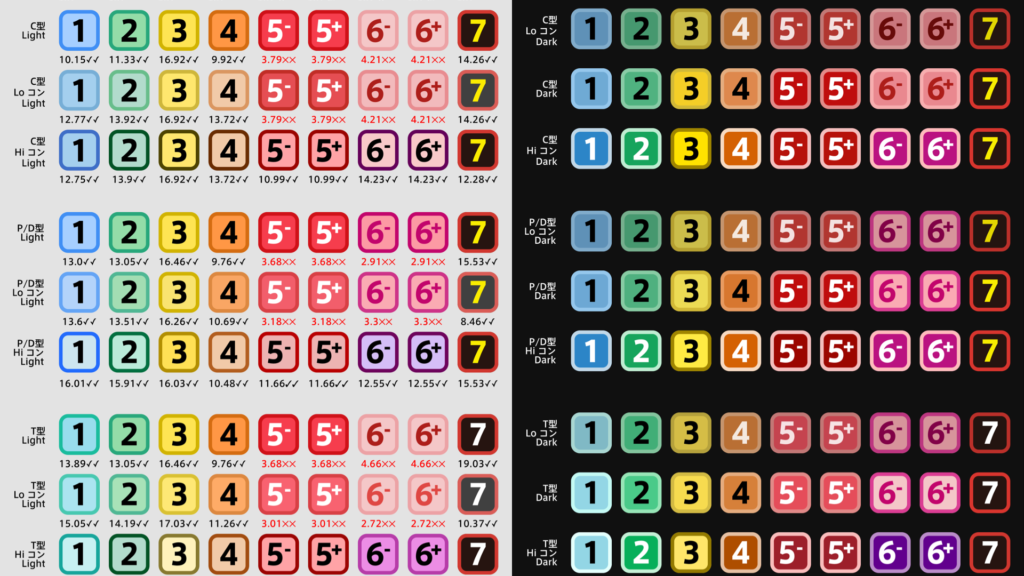
Daiki: We offer 18 variations: three color vision settings, three contrast settings, and both dark and light themes. There are also 10 different earthquake icons, each adjusted for these settings. We used a color vision simulator during the design process, tested everything on maps, and then had real users with various vision types, including older individuals, provide feedback so we could fine-tune everything.
Takashi: It’s a pretty tedious process, honestly. But from the start, everyone on the team knew it was essential.
Daiki: Fun fact, we only had a dark theme initially, and we didn’t introduce a light theme until 2022. We thought there wasn’t a need since many other apps already used white backgrounds. But after seeing a poster for Evangelion: 3.0+1.0 Thrice Upon a Time that featured a beautiful white sandy beach, I thought, “I want a fresh, sophisticated theme like that with high visibility,” and that’s how the light theme was born. Evangelion has always influenced us.
— So there’s a clear strategy behind it, but also a dash of Evangelion inspiration! What other accessibility features are you working on?
Daiki: We’ve made adjustments for screen readers. For instance, iOS’s VoiceOver and Android’s TalkBack both read out weather alerts, but VoiceOver often reads unnecessary punctuation, like middle dots, which can make the information hard to follow. So, we automatically remove those. We also register place names with phonetic guides to ensure accurate pronunciation. However, sometimes even government-provided data contains errors, so we manually correct those when necessary.
— Even official government data can have mistakes?
Daiki: Yes, our engineers have found quite a few, which we’ve reported to the Ministry of Land, Infrastructure, Transport, and Tourism for corrections. This is where our team’s deep knowledge comes in handy.
— What’s your approach to designing disaster information so that it’s easy to understand?
Daiki: One key is our custom map. Existing maps like Google Maps or Apple Maps already display a lot of data, so adding disaster information on top of them makes things cluttered. We designed our own simplified maps, spending a lot of time adjusting the color scheme.
Takashi: Another important element is the font. Our app uses AXIS Font. We’ve been using AXIS Font as something of a corporate font since we started in 2010, and when it came time to pick a font for the app, we knew it had to be AXIS. We even negotiated a license with the font company, Type Project.
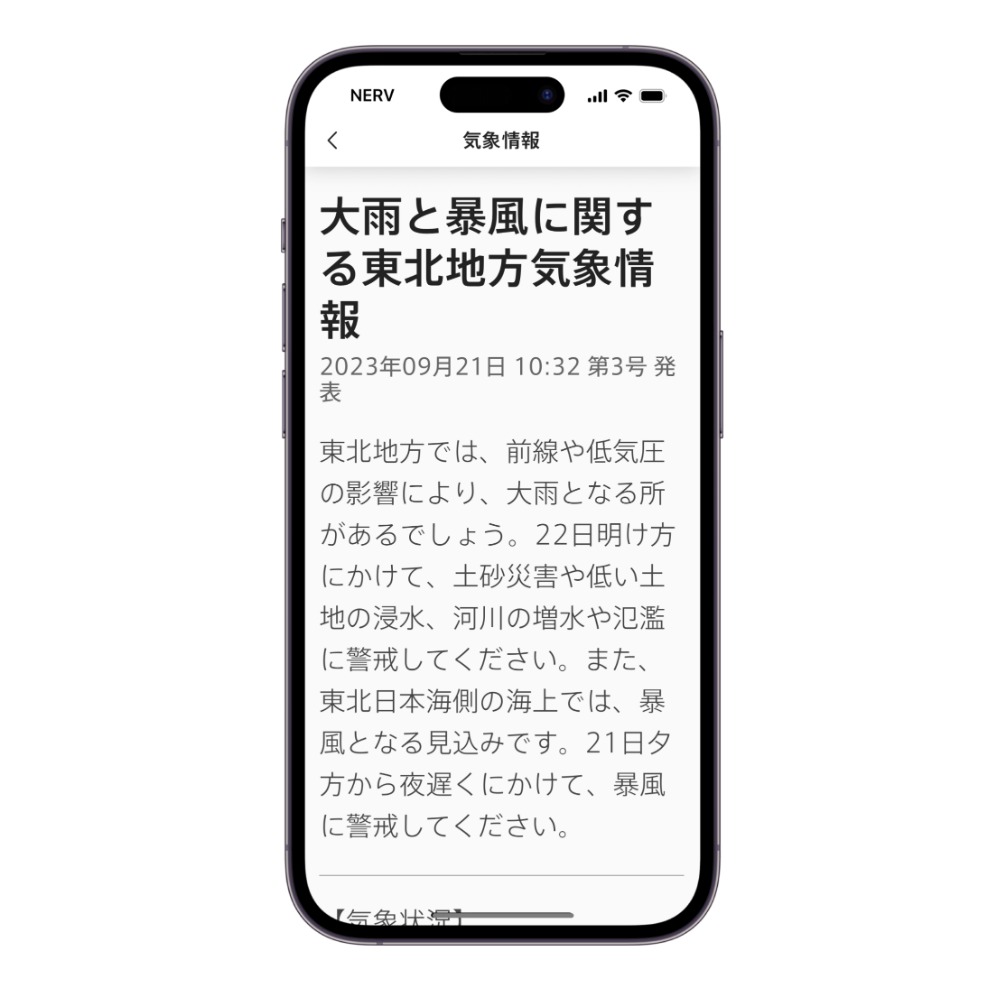
— What’s the thinking behind your font choice?
Daiki: Fonts make up about 80% of the user interface and play a huge role in conveying information. Since NERV relies heavily on text to communicate, AXIS Font, with its clarity and neutrality, felt like the perfect choice. It’s easy to read without being too harsh or cold.
Also… Takashi and I have been font enthusiasts since our junior high days. It drives us nuts that Android changes fonts to the manufacturer’s default. So, there’s definitely a bit of personal passion behind it too.
Prioritizing speed and reliability over monetization: The philosophy behind NERV Disaster Prevention
— Let’s talk about reachability. What are some strategies you’ve implemented to ensure users can quickly access the app during emergencies?
Daiki: When an earthquake hits, millions of requests flood in simultaneously, making it extremely challenging to handle. At NERV, we use cloud technology and caching to return responses quickly.
For instance, we don’t have a login feature because it would require server-side processing for data retrieval, which increases the risk of server crashes. We’ve also avoided ads, as loading them places additional strain on the network, causing delays.
Takashi: Ads are unnecessary during disasters, and they can even introduce risks like virus scams or interfere with the app’s performance. By not including ads, we’ve eliminated potential external factors that could prevent the app from functioning properly in emergencies.
Daiki: Monetizing the app is a challenge, but we didn’t want a situation where the more disasters occur, the more revenue we generate. If we included ads, it would feel like we were profiting from tragedy, which didn’t sit well with us.
— It seems this approach stems from a strong sense of conviction. Can you explain how you maintain such fast response times?
Daiki: Take our “Strong Motion Monitor Layer,” for example, which we released in September last year. This feature shows real-time earthquake tremors across Japan. We worked with the National Research Institute for Earth Science and Disaster Resilience to create a dedicated server and install a private line specifically for NERV. The system processes massive amounts of data in real time, handling countless requests per second. To distribute the data efficiently, we convert it into a unique format and push it across a large-scale network.
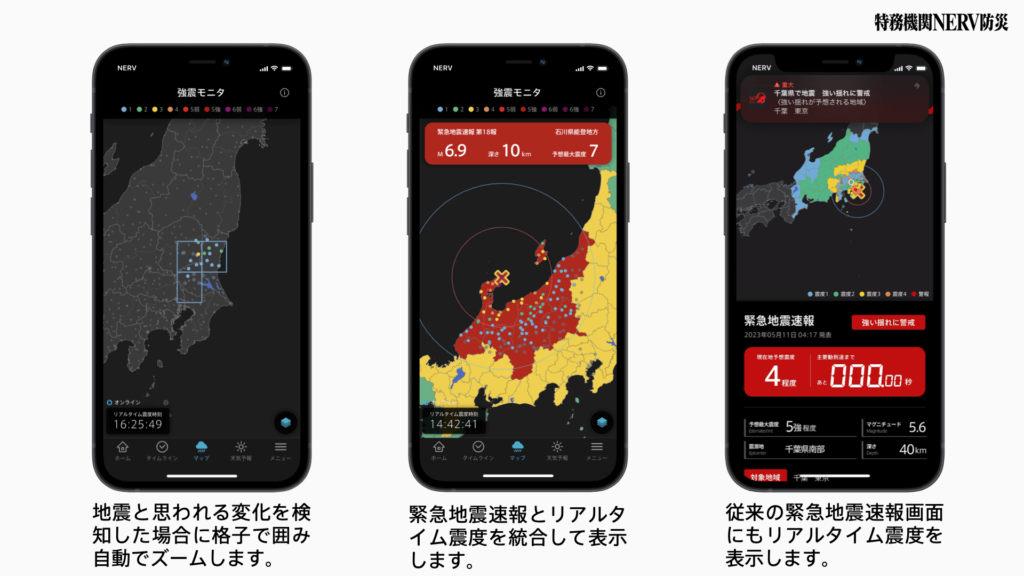
Daiki: We also implemented a single-flight mechanism. Normally, every request would fetch data from the backend, which isn’t feasible with the number of simultaneous requests we get during a disaster. Instead, we group identical requests and fetch data from the backend only once, then share that response with all grouped requests.
This significantly reduces the server load and allows us to handle high traffic with fewer resources.
Striving for notification comfort in critical moments
— Push notifications, especially for earthquake alerts, are a key feature of NERV. What do you focus on when designing them?
Daiki: We aim for comfortable notifications. For example, with flood alerts, water levels fluctuate constantly, and high tides can temporarily push levels past the danger threshold. If we sent a notification every time this happened, users would get overwhelmed. So, we limit notifications to one initial alert or exclude them entirely if we can determine it’s caused by tidal changes rather than a flood risk.
— It sounds like a lot of factors are considered when deciding whether or not to send a notification.
Daiki: We account for all relevant numerical factors when calculating alerts. However, initially, we didn’t factor in tide fluctuations, which led to unnecessary notifications. After some users reported receiving alerts when it wasn’t raining, we realized this oversight.
Similarly, when users have multiple registered locations, we group notifications to prevent them from being bombarded. We’ve incorporated many such calculations to ensure notifications are only sent when truly necessary.
— That must have been a complex design process, but it’s clearly important.
Daiki: If users receive too many notifications, they’ll start ignoring them, disable them, or even uninstall the app, and that’s our responsibility for inconvenient user experience.
Especially during disasters, users don’t want to be bombarded with irrelevant alerts. We carefully consider the user experience—thinking, what kind of notifications would I want during an emergency? before designing and implementing these features. Unlike the approach of some startups, where the focus is on launching quickly and refining later, at NERV, we prioritize getting everything right before we launch.
Learning from the past to shape the future
— It seems like every new feature you release, like the Strong Motion Monitor Layer, directly addresses user needs. How do you prioritize what to develop next?
Takashi: When we released the “River Water Level Information” in June last year, we knew we had to have it ready before the rainy season when disasters frequently occur. June is always a high-risk month for heavy rain, and we’ve seen special rain warnings issued every year around July 6th. So, we started working on it in September of the previous year. Honestly, though, a lot of it comes down to a gut feeling, like a premonition.
— For weather-related events, past data can guide development, but earthquakes and tsunamis are harder to predict.
Daiki: When we released the “Tsunami Observation Information” in 2021, it was partly motivated by the 10th anniversary of the Great East Japan Earthquake. Even after a decade, I felt like there was still a lack of sufficient tsunami information. I remember thinking, “What have we been doing for the past 10 years?” If another major earthquake were to hit, I didn’t want to regret not having improved tsunami alerts.
We managed to release it in 2021, and then in March 2022, a tsunami hit off the coast of Fukushima. In a way, it feels like our sense of urgency always aligns with critical timing.
— It seems like you both have a vast reservoir of disaster-related knowledge and memories that guide your decisions.
Daiki: That could be true. After handling so many disasters through NERV, I can vividly recall, “In such-and-such month, there was an earthquake of this magnitude in this location,” or “That typhoon landed and caused devastation.” It’s these memories that drive us to constantly update the app to avoid repeating the same mistakes. Sometimes, reflecting on past disasters reveals, “If only we’d had this feature then…” which inspires the next round of improvements.
Takashi: It took five years to develop the Strong Motion Monitor Layer, which we’d wanted from the start. Every time an earthquake hit, we felt frustrated thinking, “If only we had that feature.” Now that we’ve finally added it, we feel we’re just getting started. There are still plenty of ideas we have yet to implement.
Turning reflections into progress: Moving toward a real-world “Special Agency”
— Japan has faced numerous disasters, but has also steadily improved its response. How do you see the current situation?
Daiki: I’ve participated in discussions with the Japan Meteorological Agency and the Ministry of Internal Affairs, and I can say that everyone is serious about learning from the past and improving. After the Great East Japan Earthquake, there was an issue where they initially predicted a 6-meter tsunami. People thought they’d be safe at higher ground, but then a 30-meter tsunami hit, and many lost their lives. Since then, tsunami alerts have been revised to use more general terms like “massive” if the magnitude can’t be estimated. Announcers also deliver these warnings with more urgency. We’re developing the app in step with these advancements.
That said, even government information isn’t infallible. Our role is to provide users with the latest information as quickly as possible so they can make informed decisions. But ultimately, it’s just one tool among many.
— It’s incredible to see how a product inspired by Evangelion has evolved into something so socially relevant.
Daiki: The fact that we got permission to use the name NERV added a sense of responsibility—”We can’t release something half-baked while using the Evangelion name.” This has driven us to continuously improve the app’s design.
Of course, Evangelion is entertainment, and we’re dealing with real-world disaster information, so we have to strike a balance. But I feel we’ve reached a point where they coexist well. NERV is the result of collaboration between many organizations—the Japan Meteorological Agency, the Ministry of Land, Infrastructure, Transport, and Tourism, research institutes, broadcasters, and our supportive users. Thanks to these partnerships, I feel we’re getting closer to becoming a real-world “special agency.”
Special thanks to:
Gehirn Inc.
NERV Disaster Prevention
Written By