Designed to Stay by You: How “Sofy Be” Goes Beyond Period Care
Sofy Be is an app designed to support women’s minds and bodies as they change throughout their hormonal cycles. Going beyond basic period tracking and management, it aims to become a long-term “partner” in women’s daily lives. We spoke with the team about the philosophy behind the product and how that vision has been brought to life.
Kanako Shimomura | Product Design Manager, Unicharm Corporation
With nine years of experience, Shimomura began her career at teamLab, working on spatial design projects. She later spent six years at Recruit as a UX designer and product manager. After two years working independently as a freelance UI/UX designer, she joined Unicharm, where she now leads product design for new business initiatives.
Miho Matsuzono | Strategic Design Manager, Unicharm Corporation
After gaining experience in digital marketing, product management, and service design in the HR domain at Recruit Co., Ltd., Matsuzono joined Merpay in 2019 as a UX researcher, contributing to the launch and growth of new businesses. She is currently responsible for new business initiatives at Unicharm as a strategic designer.
Sofy Be: Helping You Notice Changes in Your Health, Not Just Your Period
First, could you tell us about the concept and key features of Sofy Be?
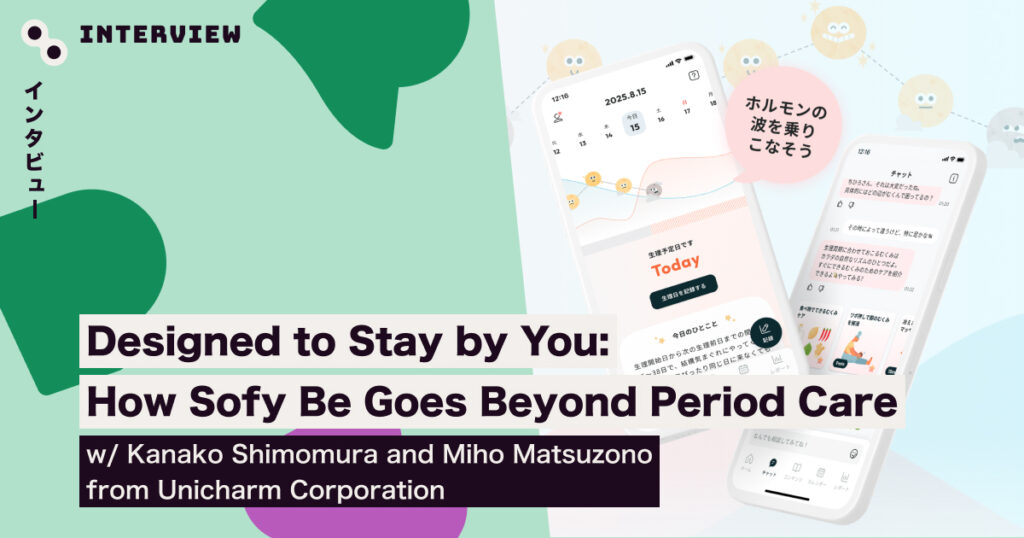
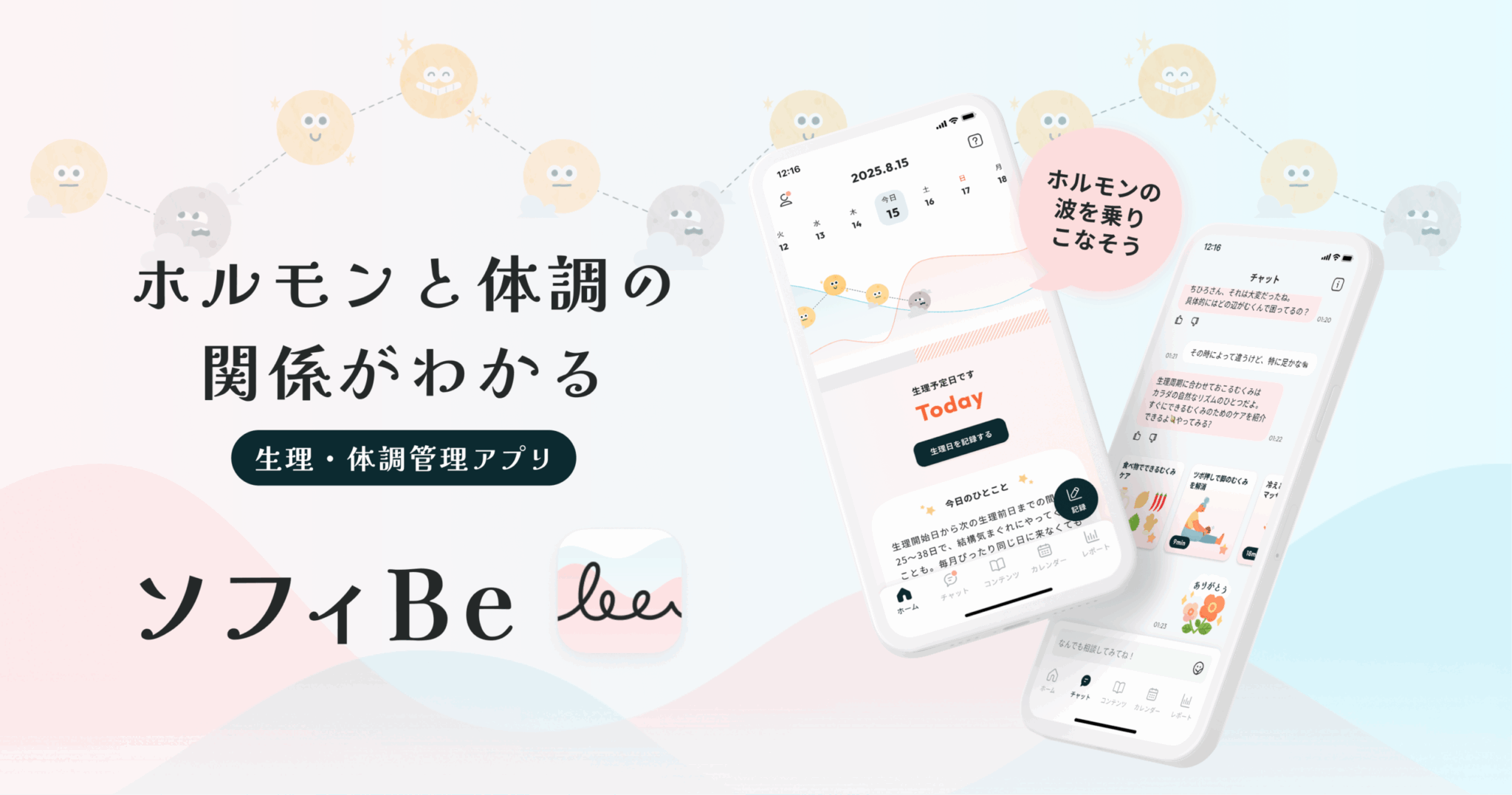
Miho: Sofy Be is a period-tracking app designed to help users understand the relationship between hormones and their physical and mental states. By focusing on hormonal cycles that influence women’s minds and bodies, the app visualizes these fluctuations in an intuitive way. Comparing hormonal patterns with their current condition allows users to think, “Maybe this is because of my hormones,” helping them better anticipate and navigate these changes. The app also features an AI chat that analyzes multiple data points to surface insights users might otherwise overlook, offering personalized self-care suggestions along the way.
Kanako: What sets Sofy Be apart, is the ability to record aspects of daily life that aren’t typically tracked in other apps, all in connection with hormonal changes. We’ve heard feedback from users like, ‘I started tracking changes in my digestion after realizing they might also be influenced by hormones.’
Could you tell us about the background behind the app and how it came to be developed?
Miho: The project began with a team that had previously worked on developing Sofy pantyliners designed to help identify optimal timing for conception. From there, they started exploring how to support women beyond the scope of menstrual products alone. This thinking led to the launch of the MDX Division as a new business unit, where various possibilities were explored, ultimately resulting in the creation of Sofy Be.
Designing Experiences Through Small Cycles That Build ‘I Can Do This’
What do you consider most important in design and development?
Miho: In line with Unicharm’s commitment to realizing a cohesive society, the MDX Division places great importance on enhancing women’s self-efficacy. In other words, fostering the feeling of “I can do this.” Drawing on interviews with athletes, user research, and academic insights, we’ve explored what elements contribute to a strong sense of self-efficacy and worked to incorporate those findings into the initial product concept. Because self-efficacy is difficult to clearly define or measure, we’re still navigating this process without one right answer.
How are you translating that concept into concrete experiences?
Miho: A state of high self-efficacy can be described as believing that “things will go well next time,” or having a positive outlook toward the future. That’s why we believe it’s important to design experiences that don’t just look back at the past, but also help users look ahead.
One example is the “This Week’s Body and Mind Forecast” feature, which helps users anticipate what they may experience in the coming days and offers tips on how to prepare. For instance, if a user sees that their period is approaching and headaches are likely, they might choose to take medication earlier than usual. By repeatedly having these moments of preparation, users build confidence in their ability to manage their condition. We intentionally design these small feedback loops to reinforce the feeling of “I can handle this.”
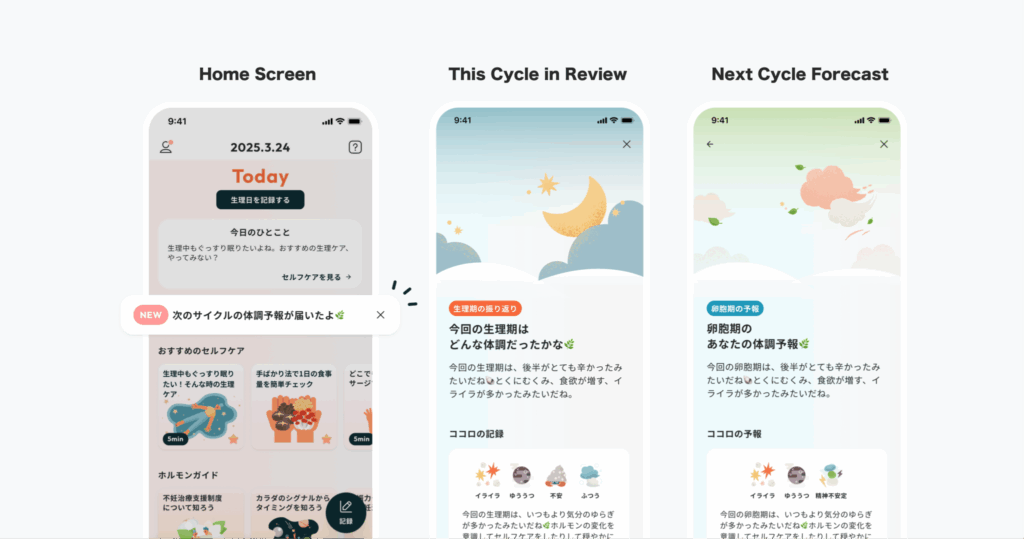
From a design perspective, what areas did you focus on most?
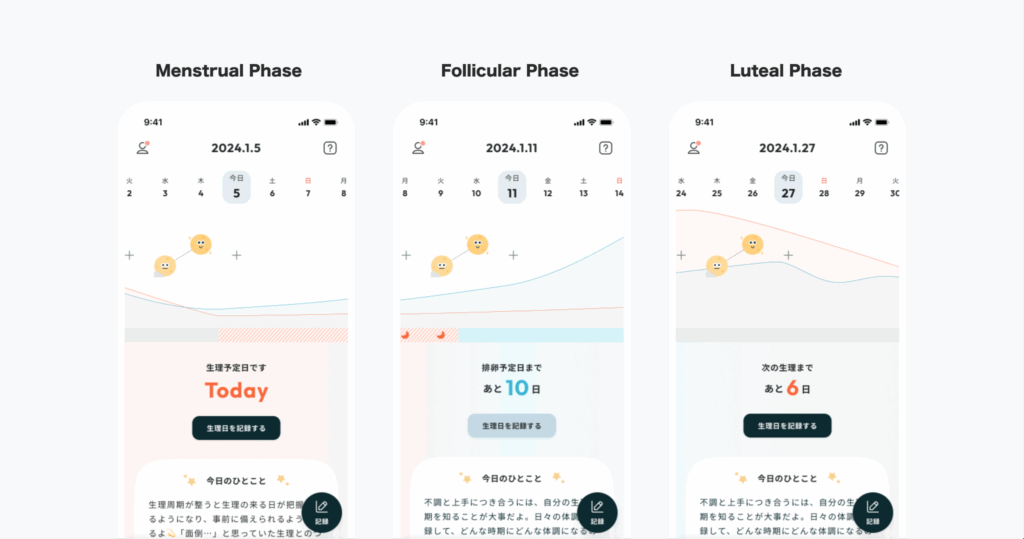
Kanako: The most challenging part was figuring out how to visually express the idea of “managing hormones.” Menstrual care is often associated with pink, so we wanted to move away from that fixed notion and guide users toward the broader concept of hormone management. To do this, we defined a set of “cycle colors” that reflect the body’s internal state: blue for estrogen and red for progesterone. These colors visually represent changes in the body. When estrogen levels are higher, the app’s background turns blue; when progesterone is dominant, it shifts to red; and during the transitional phase, it becomes gray. This allows users to intuitively understand their current condition the moment they open the app.
In addition, we’ve established clear design and illustration guidelines to maintain consistency throughout the experience.
Along with the color usage, the product conveys a sense of “kindness” and “reassurance.” Was that intentional?
Kanako: Yes, very much so. We’ve defined a clear personality for Sofy Be, built around four key traits: honest and sincere; neutral and open; not human, but friendly; and inspiring. Together, these qualities are meant to help users reflect on and better understand themselves. Based on this foundation, we also defined the moods we want to evoke such as gender neutrality and a sense of lightness, as well as those we want to avoid, like being overly stoic. These principles are then translated into visual and interaction elements, including color, behavior, textures, shapes, and illustrations.
Considering that Sofy Be aims to remain a long-term partner for women, we felt it should be more than just a simple, functional app. A sense of gentle support and human-like comfort helps the product feel more approachable. That’s precisely why defining this kind of personality was so important.
When we say “women,” we’re talking about people across a wide range of ages and menstrual experiences. How does Sofy Be address this diversity?
Miho: Rather than optimizing for individual symptoms, we focus on whether each experience contributes to our overarching goal of increasing self-efficacy. While the severity and challenges of menstruation vary from person to person, the underlying structure of becoming more positive through the accumulation of small, successful cycles is something many can relate to. We ask questions like: What does a high level of self-efficacy look like? What steps lead to that state? By working at a higher level of abstraction, we create user story maps, form hypotheses, and gradually translate them into the product.
Designing for Continuity Through Insight : A System That Responds to Your Current State.
As a long-term partner, what kinds of features or design choices help encourage users to keep using the app over time?
Miho: With Sofy Be, users can record their daily physical condition, not just during their period. For people to continue logging over time, it’s essential that they gain insights into their own physical and emotional patterns and feel that there’s real value in continuing to track their data. That’s why we analyze recorded data and offer guidance that helps users feel they’re learning how to better live in balance with their hormones and allowing them to experience the app’s value early on.
One feature that plays a key role is the AI chat. By offering real-time comments like, “There may be factors behind what you just recorded,” we believe the app can spark moments of awareness for users. For example, when I logged some stomach discomfort this morning, the AI chat responded, “You’re currently in the luteal phase, and progesterone levels are increasing, which may be slowing digestion.” That explanation really resonated with me.
Another important feature is the report function. Logged data is visualized in graphs, making it easy to compare past states with the present. Here again, we use AI to add brief comments such as, “Compared to your previous cycle, this looks like…” so users can gain insights quickly without having to carefully analyze the graphs themselves.
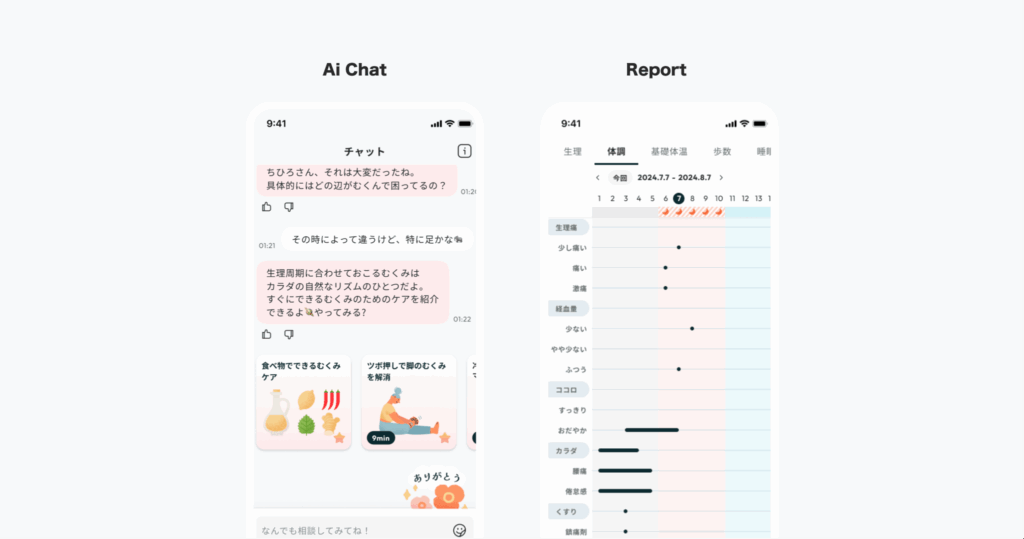
Miho: Above all, it’s important for us to stay close to the concerns users are facing right now. For users, their current discomfort is often their most pressing issue, so we analyze factors they might not notice on their own and suggest practical self-care steps they can adopt immediately. We believe this is what ultimately allows Sofy Be to become a long-term partner in helping users navigate hormonal fluctuations. We also collaborate with medical experts to inform the content we provide, which we think contributes to a sense of trust.
As the relationship continues over time, it seems likely that touchpoints beyond menstruation will emerge.
Miho: Exactly. Regardless of the life path someone follows, our goal is to offer a broad range of features that users can continue to rely on throughout their lives. In addition to the period care and fertility support modes currently available, we aim to expand into phases such as pregnancy, child-rearing, and menopause, designing the app so that it maintains meaningful touchpoints at each stage.
Balancing Expectations from Multiple Businesses While Preserving the ‘Sofy Be’ Identity
What challenges did you face in developing a new product within Unicharm, a company with a diverse portfolio of businesses?
Miho: Unicharm already had an app called Sofy, separate from Sofy Be, so development involved incorporating elements from the existing Sofy app. We needed to ensure that users transitioning from Sofy could use the new app without friction, which made organizing and prioritizing requirements particularly challenging.
Kanako: One major hurdle was the sheer number of tracking items in Sofy. The original app attempted to cover everything on a single screen, which resulted in very small text. In line with Sofy Be’s design guidelines, we had to carefully select what information to show in the first view. There were many challenges around information architecture, and this was one of the most demanding aspects of the process.
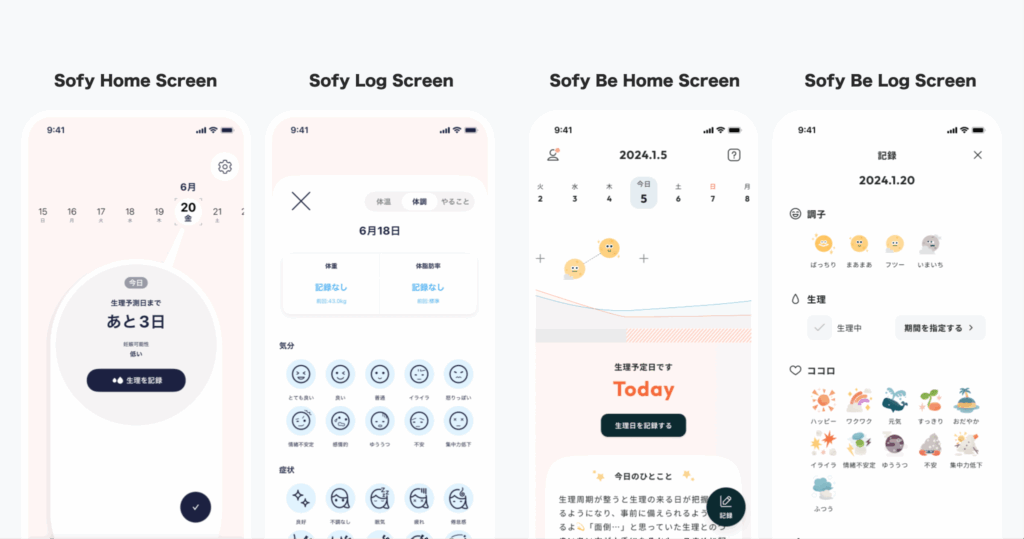
It’s interesting how Sofy Be connects with Unicharm’s insurance products and menstrual care products within the app. How did you define its position among the company’s various businesses?
Miho: Sofy aims to evolve from a menstrual products brand into a broader wellness care brand, and Sofy Be is one of the products driving that transformation. Internally, it’s positioned as a platform that can serve as a foundation for awareness and purchasing of both existing products and new business initiatives. In that sense, Sofy Be is expected to develop even more diverse touchpoints with users going forward.
Balancing those platform expectations while striving to make Sofy Be the best must require some difficult decisions.
Miho: Exactly. We’re constantly discussing various perspectives while aligning with broader business goals. For example, should we continue enhancing the existing menstrual care mode, or should we expand into new life stages to increase touchpoints? Deciding where to focus our efforts is especially critical. Personally, I believe it’s important to first establish a solid structure within the menstrual care mode that truly builds self-efficacy, and then apply that framework more broadly.
Kanako: We’re very mindful not to push our own products onto users. That’s why we take great care in how information is structured. For those who are interested, we make it possible to explore details more deeply, while ensuring that content doesn’t get in the way for users who aren’t. The visible elements are aligned with Sofy Be’s tone and personality, while information that doesn’t need to be front and center is placed deeper in the hierarchy. We pay close attention to these details throughout the design.
Sofy Be’s Ongoing Evolution in Embracing Diversity.
What kinds of insights have you gained from user feedback?
Miho: Every time we hear from our users, we’re reminded that there are still experiences we haven’t fully accounted for. For example, due to system requirements, Sofy Be sets a maximum number of days for recording menstruation. We once received a message from a user who wanted to log a longer period and shared that the limitation made them feel sad, as if the way their body worked was being denied. While there are business and technical constraints, moments like this strongly reaffirm how important it is for us to better support the diverse realities of menstruation.
Kanako: Within the menstrual care mode, users can also record the use of fertility-related pantyliners. However, we heard from people who are struggling with fertility that simply seeing the word “trying to conceive” was painful for them. We never intend to pressure anyone toward childbirth, and we believe there should be many different choices. Realizing that this wording was causing anxiety was a real wake-up call for us.
Miho: Through inquiries like these, we’re often taught about forms of menstruation and life paths we hadn’t anticipated. We want to avoid assuming that our own perspectives are the norm, and instead continue listening to a wide range of voices so that Sofy Be can be something many different people feel comfortable using.
It’s been about a year since the release. What challenges or areas for change do you see now?
Miho: The report feature in particular has continued to expand, incorporating data such as body temperature, step counts, and sleep. As a result, the complexity of the information architecture has increased. Going forward, we’ll need to revisit the structure and in some cases, even reduce features.
As we think more deeply about women’s self-efficacy, we also feel the need to consider how Sofy Be fits into a broader ecosystem that includes not only women, but also partners, companies, and other stakeholders. Rather than keeping menstruation as something only women think about, we hope Sofy Be can become a tool that enables more open conversations with others. That, to us, is what a cohesive society looks like. There’s still so much more to do.
Finally, could you share your vision for the future?
Miho: First, we want to further clarify what it truly means to improve self-efficacy and how that concept can be translated into product strategy. By gaining a deeper understanding of how users engage with Sofy Be, we hope to identify signals that indicate growing self-efficacy and feed those insights back into the product. There’s no single clear answer which makes this a challenging task, but also what makes it so interesting and rewarding.
Kanako: From a design perspective, we want to further refine the details such as animations, micro-interactions, and illustrations. Because this is a product people use every day, we’re mindful of feedback around information overload and visual fatigue. By steadily improving the finer details, we want to carefully craft an experience that’s easy to continue using and one that users can truly grow attached to.
Special Thanks to:
Unicharm Corporation https://www.unicharm.co.jp/en/home.html
Official “Sofy Be” website https://www.sofy.jp/ja/app/sofybe.html
Written By